It only takes one live cable, one active gas line or one pressurised water pipe…
The Methods And Rules Behind Dust Control For Demolition
In short: The most harmful demolition dust is too fine to see, so the controls have to be running before there’s anything visible to complain about. Water is the main one, applied so material is wet before the machine touches it. Asbestos comes out first, removed by a licensed removalist. Controlling dust is the job of the business doing the demolition, and dust that leaves the site can be reported to council.
By Sellcon, Sunshine Coast Demolition Contractor | Last updated November 2026
What’s In Demolition Dust?
Three materials account for most of the risk in older buildings, and each is handled differently.
Crystalline Silica In Concrete, Brick And Block
Concrete, brick and block all contain crystalline silica. When they’re broken up, they release a fine dust that can lead to silicosis if it’s breathed in. Silicosis is an incurable lung disease, and the dust can also contribute to lung cancer. It’s controlled with water or mist suppression while the material is being broken up.
Asbestos In Homes Built Before 1990
If your home was built before 1990, it’s likely to contain some asbestos. In a 1970s house that can mean fibro walls, roof sheeting, eaves, vinyl flooring, wet area sheeting and fences. In good condition and left undisturbed, these materials aren’t dangerous. Once disturbed, they release fibres linked to asbestosis, lung cancer and mesothelioma, which is why asbestos is removed before demolition starts.
Lead In Older Paint
Paints with high levels of lead were used in many Australian homes before 1970. The recommended limit for lead in house paint then stayed at 1% until 1992, so paint applied up to the early 1990s can still contain some lead. Lead is especially harmful to children, pregnant women and unborn babies. Queensland’s demolition code of practice says lead should be tested for wherever it’s suspected. It then calls for keeping lead dust and fumes to a minimum and cleaning work areas during and after the job.
The Controls That Keep Dust Down On Site
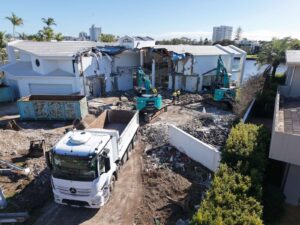
Dust control during demolition relies on water more than anything else. On our sites, that means water spray systems and temporary screening around work areas, with the property’s water kept connected through the job. We also monitor air quality throughout the project.
Three things show a site is managing its dust:
- The material is wet before it moves. Spraying ahead of the machine keeps it damp when it’s disturbed.
- There’s enough water, and no more. That means enough to keep visible dust down, without adding weight to the debris or running water into the building next door.
- Nobody sweeps it dry. Dry sweeping and blowers put settled silica dust back into the air.
What Has To Happen Before The Machines Arrive?
Wetting a building down doesn’t make it safe to demolish with asbestos still in it. Queensland law requires asbestos to be removed before demolition starts, wherever reasonably practicable. Power tools and high-pressure water should never be used on it.
You can’t tell asbestos by looking, so the check comes first. More than 10 square metres of non-friable asbestos, where the fibres are bonded, needs a Class A or B licensed removalist. Friable asbestos, the loosely bound kind, needs Class A.
We don’t remove asbestos ourselves. We flag anything suspect at the site assessment, then coordinate removal by licensed subcontractors and check the clearance paperwork before we start.
Who Is Responsible For Dust On A Demolition Site?
The business doing the demolition is responsible, under two sets of rules.
- Work health and safety law comes first, enforced by WorkSafe Queensland. Since 1 September 2024 it has required dust controls, such as wet suppression, whenever concrete, brick and other materials containing crystalline silica are crushed, cut, ground or drilled with power tools or machinery. Queensland also has a silica dust code of practice for construction work, which includes demolition.
- Environmental law is the second set. Dust nuisances are regulated under the Environmental Protection Act 1994, and Sunshine Coast Council investigates complaints.
As the owner, you aren’t running the site, and both sets of rules are aimed at whoever is doing the work and making the dust.
Questions To Ask A Demolition Contractor About Dust
- Where does the water come from on my site? A good answer names the supply, either the property’s own connection or a water truck.
- Who checks for asbestos, and who removes it? The removalist’s licence class should match the job, and anything friable needs Class A.
- How will my neighbours be told? They should hear before the start date and be given the work schedule. Notifying neighbours is one of the steps in our demolition checklist.
- Who licenses you? In Queensland, a demolition licence is issued by WorkSafe Queensland. Ask to see it.
Frequently asked questions
Does the water need to stay connected during demolition?
On our jobs, yes. Water is needed for dust suppression, so we keep it connected while the other services are disconnected. The Demolition Work Code of Practice 2021 allows for this. Services not required for the demolition should be shut off or capped before work starts, and a service retained for the work should be adequately protected. Electricity, gas and the rest still come off first. Our article on disconnecting utilities before demolition covers how.
What happens if a neighbour complains about dust?
Sunshine Coast Council recommends that people try to resolve a dust problem with whoever is responsible first, so make sure your neighbours have the contractor’s number. If that fails, council can investigate, and the neighbour will be asked to keep a nuisance diary. Where council finds a breach, its options are a warning, a direction notice, an on-the-spot fine or prosecution.
Will there still be some dust during a demolition?
Some, yes. Wet methods limit dust. They don’t remove all of it. What you shouldn’t see is dry concrete or brick being broken up or loaded with no water on it. If you do, raise it with the contractor on the day.
What should I tell my neighbours before the demolition?
Give them the dates, the contractor’s name and a phone number. Tell them the asbestos check comes first and that any asbestos is removed by a licensed removalist before the building comes down. On demolition days they can close windows, bring in washing, move cars and cover the pool. On our jobs, we give neighbours advance notice of the work schedule as well.
Planning a demolition on the Sunshine Coast?
Dust is one of the things we plan for at the site assessment, along with access, asbestos and the neighbours. The assessment is free, and it’s the first step in all our demolition services.
About The Author
Sellcon, Sunshine Coast Demolition Contractor
Sellcon is a locally owned and operated demolition expert, licensed through WorkSafe Queensland. This article draws on 16+ years of residential, commercial and industrial demolition work on the Sunshine Coast.
Related Posts